
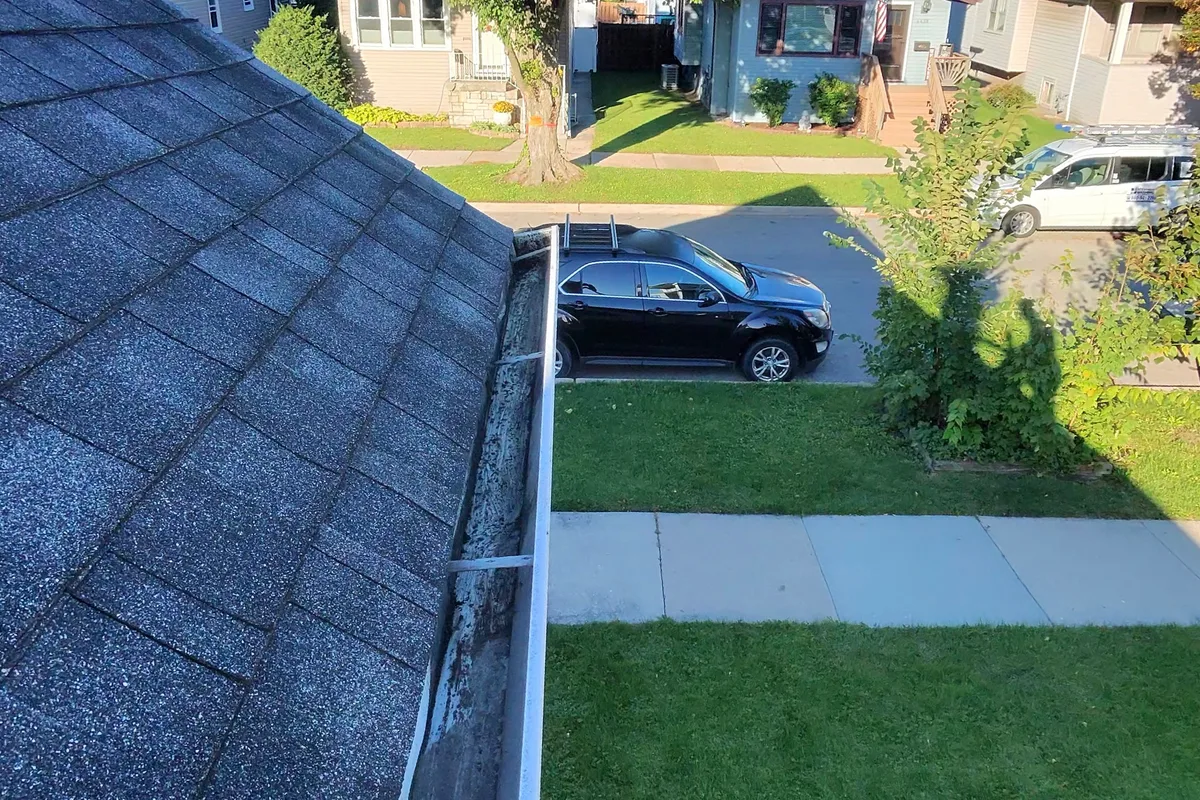
The 30-second version
- A little grit is normal. Every asphalt roof sheds some granules, and a new roof sheds the most in its first months.
- A gutter that looks like a gravel bed is not. Heavy, dark, sandy buildup usually means the shingles are aging and it’s time to have a roofer look.
- Either way, the gutter still has to drain. Granules sink, pack and settle at the downspout opening. On the Chicago job below, clearing them cost $120.
Most homeowners expect to find leaves when they look in their gutters. Fewer expect sand. But if you have ever pulled out a handful of dark, gritty sludge that felt like wet beach sand, you have already met the topic of this post: shingle granules in gutters.
We see it more often than you would think. In 9 of the 69 gutter jobs we have published this year, the crew’s notes call out shingle grit or granules by name. The clearest example came in on October 5.
The job
A Chicago bungalow where the gutters had turned into a gravel bed
Davey, from our Chicago crew, took a one-story house on North McVicker Avenue on Chicago’s Northwest Side. It’s the kind of block we know well from years of gutter cleaning in Chicago: bungalows and frame houses shoulder to shoulder, parkway trees out front, and roofs that have been through a lot of freeze-thaw winters.
The gutters were not full of leaves. They were full of stone. The asphalt shingles had been shedding their mineral coating, and every rain had washed that grit off the roof and into the troughs. As the job record puts it, the channels were “more gravel bed than drainage path.”
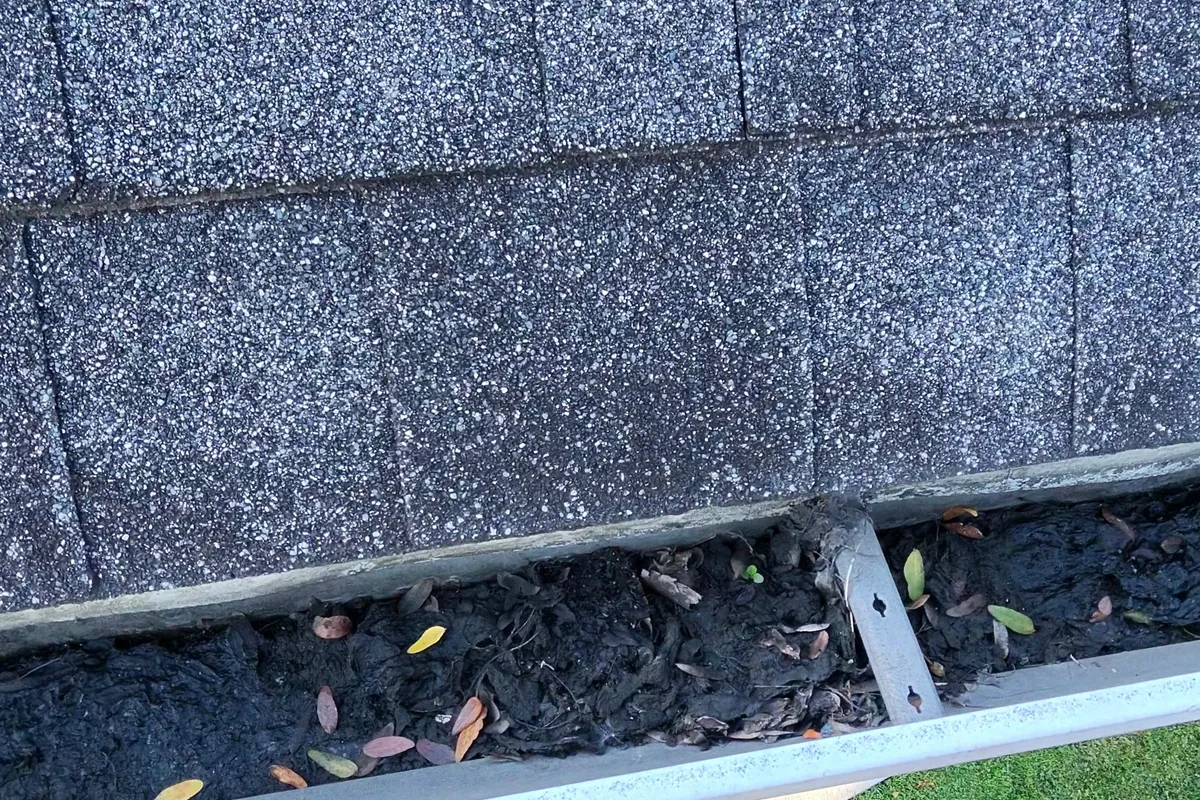
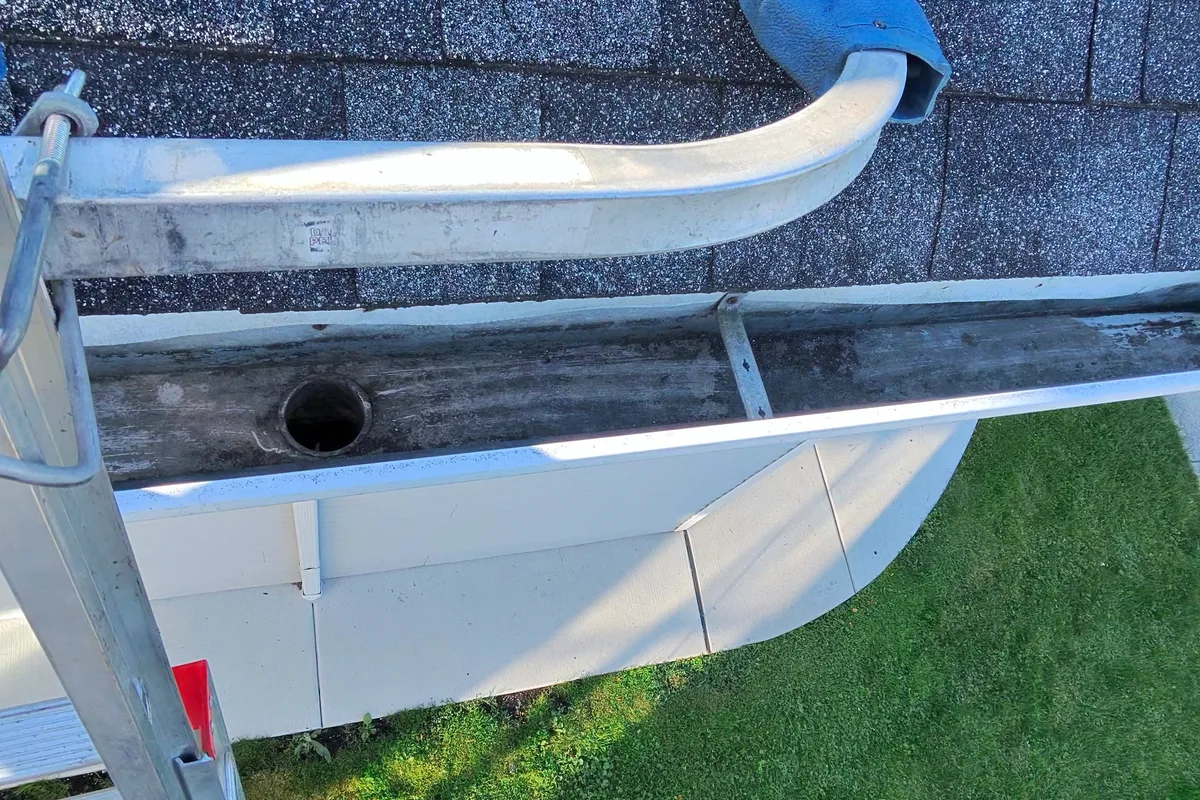
Look at the before photo closely. There are maybe a dozen leaves in it. Everything else is a dense black mat of shingle granules and fine organic matter, sitting in the gutter like wet concrete that never set.
The fix was hands-on. Davey cleared the buildup by hand and by scoop around the whole roofline. Because the volume of stone was well beyond a normal seasonal leaf load, he checked that every downspout entry was fully open before moving on, then flushed each run to confirm the water moved. Everything ran clean, and the invoice went out the same day.
- Service
- Gutter cleaning + downspout flush
- Where
- N. McVicker Ave, Chicago, IL
- Home
- 1-story house
- Main debris
- Shingle granules, packed
- Crew
- Davey — Chicago team
All five photos from the visit are on the Chicago project page.
The material
What those granules actually are
An asphalt shingle is a mat soaked in asphalt, with a layer of crushed, colored mineral granules pressed into the top. Those granules do two jobs: they give the roof its color, and they shield the asphalt underneath from sunlight. Without them, asphalt dries out, gets brittle and cracks.
Granules are only held on by the asphalt. As a shingle ages, the asphalt hardens, its grip weakens, and the stones start to let go. Chicago winters speed that up. Water gets under the edge of a granule, freezes, expands, and pries a little more loose every cycle.
The National Roofing Contractors Association puts this sign right on its homeowner checklist: twice-a-year roof inspections, it says, often catch excessive surface granules accumulating in the gutters or downspouts. In other words, your gutters are one of the easiest places to read the condition of your roof without climbing onto it.
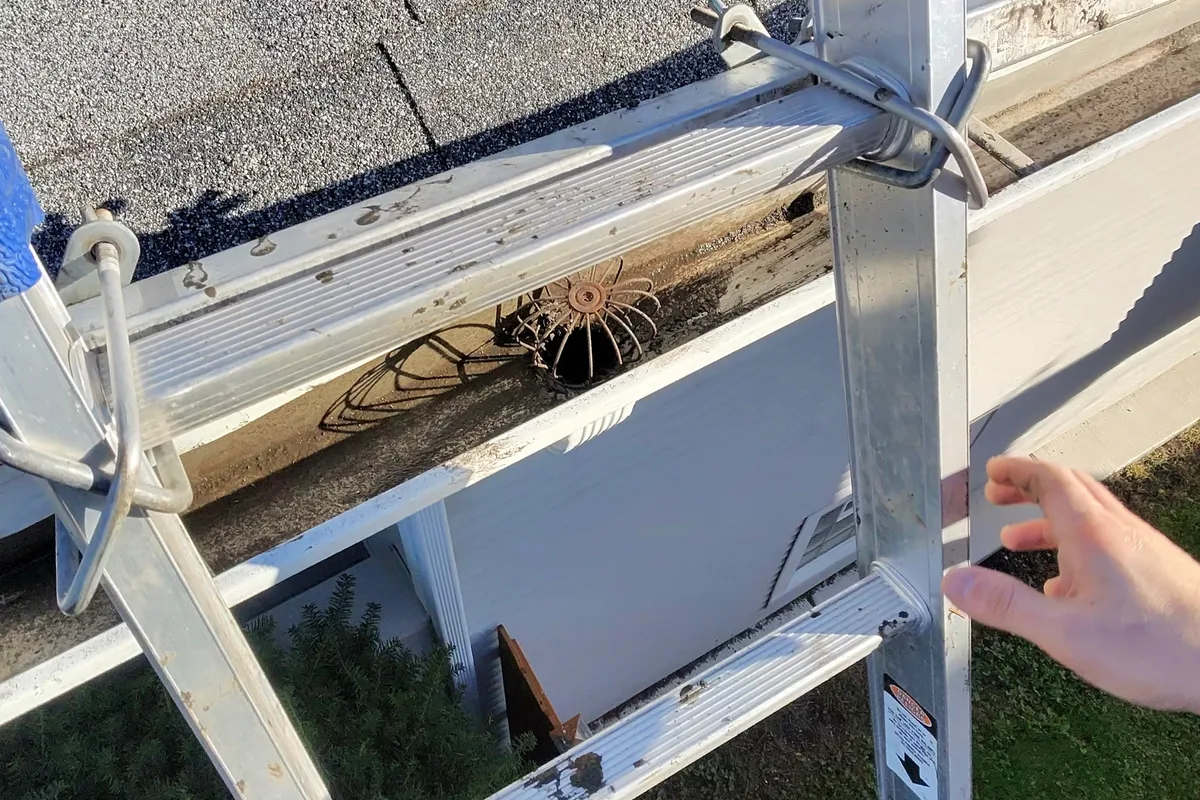
This photo from the same job shows why granules cause trouble. That wire basket over the downspout opening does a decent job of stopping leaves. Granules are smaller than the gaps, so they collect around the base of it as a sandy sediment and keep building until the opening chokes.
The judgment call
Normal shedding, or a roof that needs attention?
Finding granules does not automatically mean you need a new roof. Here is how we’d read it.
Usually normal
- A light dusting of grit along the bottom of the gutter
- A roof installed within the last several months
- Small piles at downspout outlets after a big storm, then not much after that
- Shingles that still look an even color from the ground
Worth calling a roofer
- Gutters packed with sandy sludge, like this Chicago job
- Shedding that is still heavy many months after a new roof went on
- Dark, shiny or bald-looking patches on the shingles
- A sudden jump in grit right after a hailstorm
The new-roof case is the one that worries people most, and usually shouldn’t. Shingles leave the factory carrying extra loose granules, and they rub off during handling and the first few rains. GAF, one of the largest shingle makers, says in its technical bulletin on granule loss on new shingles that this early shedding is normal, is not a manufacturing defect, and tends to settle down after several months. If it is still heavy after that, or the roof starts to change color, that is the point to contact the installer.
Hail is the other trigger, and 2026 has given Illinois plenty of it. You don’t need golf-ball hail to do damage. Research from the Insurance Institute for Business & Home Safety shows that repeated small hail strips granules off asphalt shingles, and that weathered shingles hit by two rounds of small hail became up to ten times more vulnerable to damage from later large hail. If your gutters suddenly fill with grit after a storm, take photos before you clean them out. They are useful evidence if you end up talking to your insurer.
The price
What it cost, and what one-story homes paid this year
The McVicker Avenue job invoiced at $120. That is the bottom of our published gutter cleaning prices for a one-story home. Granules make a gutter heavier and messier, but on a single-story roofline with downspouts that still opened, they did not make it a bigger job.
Across the 14 one-story gutter cleanings we published in 2026, invoices ran from $120 to $195. Five came in at exactly $120 and eight of the 14 came in at $130 or less. Across all 69 gutter jobs, two-story homes included, the median was $180.
Where granules can change the price is when they have been left long enough to set up in the downspouts. Sediment that settles in an elbow and dries can turn into a plug that has to be broken out by hand, and that is labor no base rate covers.
The risk
Why a gutter full of granules is worse than one full of leaves
Leaves are bulky but light. Water still finds paths around and through them, and a strong rain often pushes them along. Granules behave differently:
- They sink and pack. Granules settle to the bottom of the trough and lock together into a dense layer that water runs over instead of along.
- They are heavy. A wet run of packed granules weighs far more than the same run of leaves, which strains hangers and can pull a gutter out of pitch.
- They go where the water goes. Granules collect exactly at the downspout opening, which is the one spot that has to stay clear.
When that opening chokes, the water goes over the front edge and lands right at the base of the house. That is how a roof problem quietly becomes a basement problem, and why keeping gutters draining is the cheapest thing you can do to protect your foundation.
From our side
What we tell homeowners from the ladder
- We clean gutters. We don’t sell roofs. When we pull out a gutter full of granules, we tell you, we send photos, and we suggest you have a roofer look. We have no roof to sell you, so you can take that at face value.
- Your gutter debris is a roof report. Leaves tell us about your trees. Granules tell us about your shingles. We’d rather you hear it from a $120 gutter visit than from a ceiling stain.
- Do the gutters before the glass. On October 5 our Chicago crew was also in Skokie, where they cleared a one-story home’s gutters for $120 and then did its window washing afterwards. That order matters. A clogged gutter that overflows in the next rain sends dirty water down freshly cleaned glass.
- Regular beats rescue. A routine visit is quick and predictable. Waiting is what gets expensive. A week before this job, an overdue job in Antioch cost $600 because every downspout elbow had set solid.
The next step
If your roof turns out to need replacing
If a roofer confirms the shingles are near the end of their life, Chicago homeowners should know the city has a fast lane for the paperwork. The Department of Buildings’ Express Permit Program covers a reroofing permit for roof repairs, recovers and full replacements. Ask any roofer you interview whether they are registered with the city and who will pull the permit.
One practical tip: schedule a gutter cleaning after a reroof, not before. A tear-off and install sends a burst of loose granules and debris into the gutters, and a new roof keeps shedding its extra granules for a while after that.
The timing
When to get granule-heavy gutters cleaned
Granules don’t follow the leaf calendar. They wash down with every heavy rain, all year. If you know your roof sheds, a spring cleaning matters as much as a fall one. In the fall, wait until most of the leaves are down so one visit clears both. Our guide on when to book gutter cleaning lays out the month-by-month calendar for the Chicago area.
Before you call anyone, take two minutes to check:
- Scoop a handful from the gutter near a downspout. Mostly leaves, or mostly grit?
- Look at the ground under the downspout outlets for small piles of colored sand.
- From across the street, look at the roof for patches that are darker or a different color than the rest.
Not sure what’s in your gutters? We’ll clear them, flush every downspout, and send you photos of what came out, granules included. Every price is confirmed on site before work starts. Call (847) 297-4492 or book online.
Questions
Shingle granules in gutters: common questions
Is it normal to have shingle granules in gutters?
A small amount, yes. Every asphalt shingle roof sheds some granules as it ages, and a new roof sheds extra loose granules in its first months. A light layer of grit is normal. Gutters packed with sandy sludge, shedding that stays heavy many months after a new roof, or bald patches on the shingles are signs to have a roofer inspect the roof.
Do granules in my gutters mean I need a new roof?
Not on their own. Heavy, ongoing granule loss usually means the shingles are aging, but the amount, the age of the roof and the condition of the shingles all matter. Use what is in your gutters as a reason to get a roofer’s opinion rather than as a verdict.
Can shingle granules clog gutters and downspouts?
Yes. Granules sink to the bottom of the gutter and pack into a dense layer, and they collect at the downspout opening. Wire downspout strainers stop leaves but not granules, so grit builds up around them. Left long enough, the sediment can set into a plug inside the downspout elbow.
How much does it cost to clean gutters full of shingle granules?
On our October 2026 job in Chicago, clearing granule-packed gutters on a one-story house cost $120. Across 14 one-story gutter cleanings we published in 2026, invoices ran from $120 to $195. The price rises when granules have hardened into plugs inside the downspouts and have to be broken out by hand.
Should I clean my gutters after hail?
Check them first. A sudden jump in granules after a hailstorm can be a sign of roof damage, so photograph what is in the gutters and around the downspouts before cleaning them out, and consider having the roof inspected. Then get the gutters cleared so the next rain can drain.
How often should gutters be cleaned if my roof sheds granules?
At least twice a year, once in spring and once in late fall after the leaves are down. Granules wash off the roof with every heavy rain rather than arriving in one season, so a roof that sheds heavily benefits from the spring visit as much as the fall one.