
Short answer: gutter guards reduce how often gutters need cleaning. They do not end it. On most homes they change where the blockage forms rather than whether one forms at all — and the place it usually forms is the one part of the system no guard covers.
We can put real numbers on that, because we write up and publish every job we run. Of the 45 residential gutter cleanings we published in 2026, seven were homes that already had guards installed. All seven still needed the gutters cleared by hand. In six of the seven, water had stopped moving inside a downspout or a downspout elbow — below the guard, in the part of the system a guard was never designed to protect.
So if you are asking whether you still need to clean gutters with gutter guards installed, what follows is evidence rather than opinion. Below is what we found on each of those seven homes, one job in full detail with photos, how each style of guard fails, how often guarded gutters actually need service, and a ten-minute check you can run yourself before calling anyone.
About this data — read this first
These seven homes are not a random sample. They are homes that called a gutter cleaner, so they are selected for having a problem. A guard that is quietly doing its job never generates a service call, and plenty of them do. What this set shows is not how often guards fail, but what failure looks like when it happens, and which part of the system gives out first. Every price, footprint and finding below is taken from our own published project records.
What a Gutter Guard Actually Does — and Four Things It Doesn’t Stop
A gutter guard is a filter over the trough. It is good at what it was built for: keeping whole leaves, twigs and roof debris out of the channel. That is a real benefit, and on the right house it turns three service visits a year into one. But a filter has to put what it catches somewhere, and it only protects the few inches of the system it physically covers.
1. Fine debris still gets in
Shingle grit, pollen, maple seed wings, oak tassels, roof granules and windborne dirt are all smaller than the openings in most guards, or fine enough to work through mesh over time. Once wet, they settle into the bottom of the trough as a dense organic paste that hardens between rains. It is not dramatic and it is invisible from the ground — but it is what we scrape out of guarded gutters most often, and it is what eventually washes down into the downspout.
2. Debris stacks on top of the guard
The debris the guard blocks does not vanish. On a flat mesh or screen it forms a mat, and once that mat is wet and compacted, rain sheets straight over the outer edge instead of passing through. From the driveway everything looks right: the gutter is clean, the guard is intact, and water is pouring over the front lip in every storm. On the Evanston house further down this page, the guards had collected their own layer of compacted seed pods and shingle grit — blocking flow just as thoroughly as an open, packed gutter would have.
3. The downspout and the elbow are completely unprotected
This is the big one. Everything fine enough to pass the guard travels along the trough to the outlet and into the downspout, where it reaches the elbow — the bend at the top or bottom of the run. Water slows at a bend. Sediment drops out of slow water. That is where the plug forms, and no guard on the market covers it. In six of our seven guarded homes this year, the elbow or the downspout was the actual blockage.
4. Ice, valleys and heavy-flow events don’t care about guards
Guards do not prevent ice dams. Standing water in a trough that is not draining will freeze whether or not there is a screen on top, and a frozen micro-mesh panel filters nothing at all until it thaws. Roof valleys concentrate the runoff from a large area into one short section of gutter, and in a hard rain that column of water can overshoot a reverse-curve guard entirely.
What We Found Under the Guards on 7 Homes This Season
Every one of these is a published project with photos on our site. Footprint is the home’s square footage, and the price is what the job actually invoiced — not an estimate.
| Job | Home | What was under the guards | Invoice |
|---|---|---|---|
| June 2026 Cary, IL | 2-story 3,811 sq ft | Fine sediment and decomposed leaf matter had worked through the guards and packed the troughs; at least one downspout clogged through | $400 |
| July 2026 Cary, IL | 2-story 2,152 sq ft | Guards screwed down rather than clipped; gutters packed solid through, not partially — elbows clogged through as well | $225 |
| July 2026 Barrington, IL | 2-story 2,700 sq ft | Debris above and beneath the guards; elbows packed solid and blocking flow entirely — plus a live nest sheltering above a downspout | $225 |
| August 2026 Grayslake, IL | 2-story 5,813 sq ft | Entire first-floor run effectively sealed off — debris packed in behind the guards; elbows had stopped flow completely | $250 |
| August 2026 Deerfield, IL | 2-story 2,100 sq ft | A season of leaf and seed matter had built up quietly behind the guards until the channels underneath were packed solid | $185 |
| August 2026 Lincolnwood, IL | 2-story 2,001 sq ft | Compacted leaf debris, seed clusters and fine organic paste around the full perimeter; one downspout fully clogged | $170 |
| August 2026 Evanston, IL | 3-story 4,200 sq ft | Compacted seed pods and shingle grit sitting on top of the guards; downspouts backed up completely (roof cleaning included in this job) | $475 |
Read the column that matters. In six of the seven, the failure had reached the downspout or the elbow. The trough was rarely the whole story, and on two of the homes the guards themselves had become the blockage — the debris never got into the gutter at all, it sat on the lid and sent the water over the edge.
One Job in Full: Three Stories in Evanston, Where the Guards Became the Filter
On August 31, 2026, our technician Timothy took a three-story house on Asbury Avenue in Evanston — 4,200 square feet of footprint, guards along the roofline, and every downspout backed up. It is the clearest example we have of the failure mode homeowners never see, because it was happening on top of the guards, three stories up, where nobody looks.
Project Snapshot
- Service
- Gutter cleaning with guards, plus roof cleaning
- Location
- Evanston, IL — Asbury Avenue
- Home type
- 3-story house
- Area serviced
- 4,200 sq ft footprint
- Guards
- Installed along the full roofline
- Condition found
- Downspouts backed up completely; compacted seed pods and shingle grit on top of the guards
- Project price
- $475 (gutters, guards and roof cleaning)
- Technician
- Timothy — Chicago team
- Completed
- August 2026
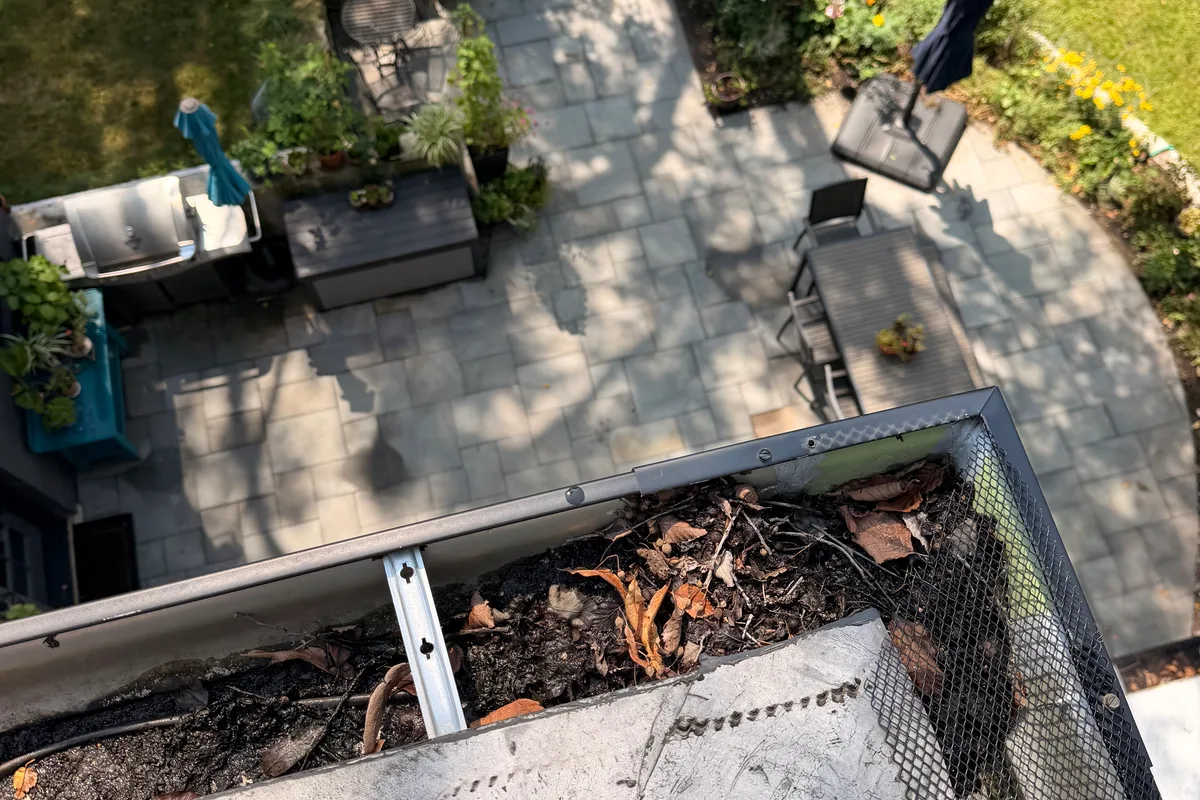
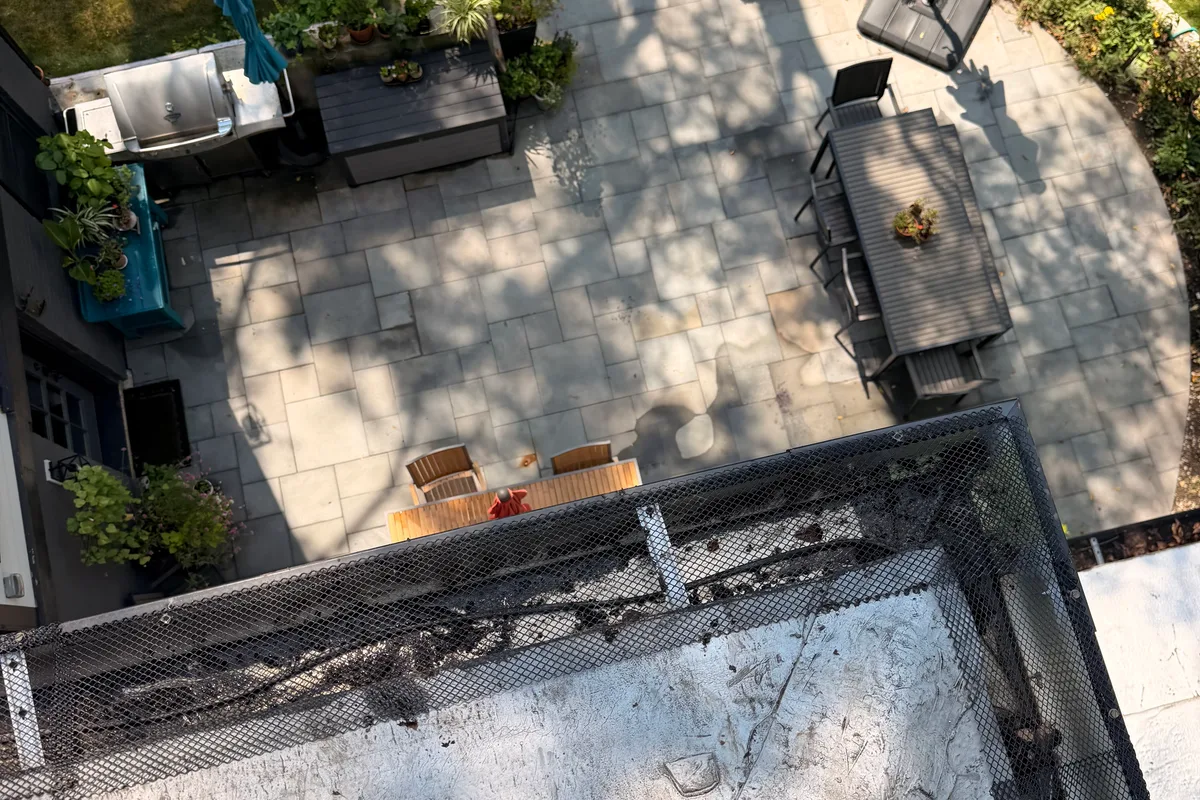
Guards were in place, which on paper should have meant less debris in the system. What they had done instead was collect a layer of compacted seed pods and shingle grit on their upper surface, blocking flow as thoroughly as an open gutter packed with leaves. Underneath, enough organic material had worked through to back the downspouts up entirely.
Three-story work is slower by nature — every elevation needs deliberate ladder staging and there is no shortcut for it. Timothy moved around the house one elevation at a time: clearing the guards, flushing the troughs, then forcing each clogged downspout open from the top down until water ran clean out of every outlet. The roof cleaning ran alongside it, deliberately in that order, so surface debris came off before it could wash back down into a system that had just been cleared.
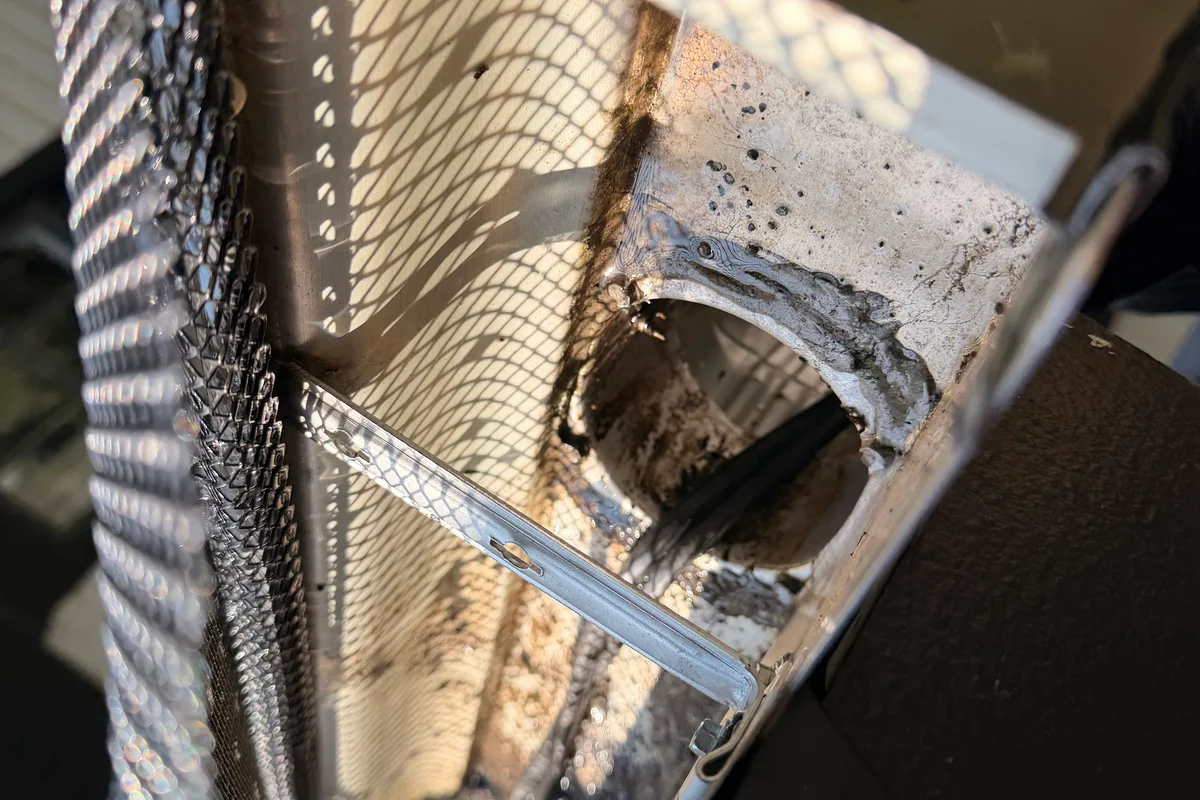
A house this tall and this large takes most of a day when the flush-through is done properly. The full write-up, more photos and the crew details are on the Evanston gutter cleaning project page.
Guard Types, and How Each One Fails
“Gutter guard” covers five quite different products, and they do not fail the same way. Knowing which one you own tells you what to check and what a cleaning will involve.
| Guard type | How it works | Typical failure | What cleaning involves |
|---|---|---|---|
| Micro-mesh | Fine stainless or aluminum mesh over the trough; water passes, most solids do not | The mesh blinds over — pollen, shingle grit and a wet leaf mat seal the surface so rain sheets over the edge | Usually cleaned from above: brush the surface, flush the mesh, then check every downspout separately |
| Perforated / screen | Punched aluminum or plastic panel; debris sits on top, water drops through the holes | Fine debris passes straight through and packs the trough; panels lift or pop loose in wind | Panels lifted or unclipped section by section, trough cleared by hand, panels re-secured |
| Reverse-curve / surface tension | Solid cover; water wraps around a curved nose into a slot while debris carries past | Debris lodges in the nose slot; heavy valley runoff overshoots the curve entirely | The slowest to service — covers often have to come off and be refitted to reach the trough |
| Foam inserts | A wedge of foam fills the trough; water passes through it, debris stays on top | Debris embeds in the foam itself, holds moisture, and seedlings root in it — the guard becomes the clog | Foam is pulled out, trough cleared, foam replaced if saturated or degraded |
| Brush inserts | A large bristle cylinder sits in the trough; debris catches in the bristles | Catches everything, including the fine material it was supposed to let pass | Pulled out, shaken clear, trough flushed, refitted |
One practical note before you buy: ask how the guard is fastened. Clipped panels lift in seconds. Screwed-down guards — like the ones on that second Cary house — add removal and reinstallation time to every run of the roofline, and that time shows up on every future invoice for the life of the product.
How Often Do Gutters With Guards Need Cleaning?
These are the intervals we schedule on. They assume the guards are intact and correctly fitted; the heavier your tree cover, the more a guard buys you in convenience and the less it buys you in skipped visits.
| Tree cover over the roof | Without guards | With guards |
|---|---|---|
| No overhanging trees | Once every 1–2 years | Every 2–3 years (inspection, not always a full clean) |
| Light canopy nearby | Once a year | Every 18–24 months |
| Moderate canopy over part of the roof | Twice a year | Once a year |
| Heavy canopy — mature oaks or maples directly overhead | Two to three times a year | Once or twice a year |
| Pines or spruce within dropping distance | Twice a year | Twice a year — guards help least here |
Pine needles deserve the footnote. They are the worst case for every guard on that list: thin enough to thread through mesh and screens, stiff enough to weave into a mat on top of the ones they cannot pass. Under pines, buy guards for the convenience of fewer whole leaves, not for a longer service interval. Our general guide on how often gutters should be cleaned covers unguarded homes in more depth.
The 10-Minute Check for Guarded Gutters
Do this from the ground and from an upstairs window. You do not need to go on the roof, and you should not need a ladder for any of it.
- Watch a downspout during rain, or run a hose into the gutter. A clear system gushes. A trickle, or a delay of several seconds before anything appears, means a plug in the pipe — the single most reliable test there is.
- Look down at the top of the guard from an upstairs window. You are looking for a mat: matted leaves, seed clusters, or a dark stain across the mesh. That is the failure you cannot see from the driveway.
- Knuckle-tap the downspout from bottom to top. An empty pipe rings hollow. Where the note goes dull and dead, that is the top of the plug.
- Look at the ground along the gutter line. A trench in the mulch, splash staining on the siding, or a drip line in the soil means water has been coming over the front edge instead of out the downspout.
- Check the fascia board and soffit behind the gutter for streaking, peeling paint or dark water marks — the first visible evidence of chronic overflow. In winter, a row of icicles along one section means standing water sat there and froze.
If any of those flags come up, note how your guards are attached — clipped or screwed — before you call. It is the first thing any honest company will ask, because it is what the quote depends on. Our walkthrough on clearing clogged downspouts covers the DIY methods worth trying before you book anyone.
Does Gutter Guard Cleaning Cost More Than Standard Gutter Cleaning?
Guards have to come off, or at least be lifted and re-secured, on every run of the roofline. That is labor, and a company that tells you otherwise is either not removing them or not charging you honestly. Our published base rates for gutter cleaning are:
| Home footprint | 1 story | 2 story | 3 story |
|---|---|---|---|
| Under 2,000 sq ft | $120 | $150 | $200 |
| 2,001 – 3,000 sq ft | $130 | $170 | $225 |
| 3,001 – 4,000 sq ft | $150 | $200 | $250 |
| 4,001 – 5,000 sq ft | $175 | $225 | $300 |
| 5,001 – 6,000 sq ft | $200 | $250 | $350 |
Those are base cleaning rates. When guards are installed, a guard-handling fee is added on top based on footprint and guard style, and every price is confirmed with an on-site estimate before work begins. What the seven jobs above show is what that surcharge looks like in practice: of the five that fall inside the published bands, four invoiced above the base rate for their size and one landed exactly on it. The whole set ran from $170 to $475, with a median of $225. Details are on our cleaning gutters with guards page, and the full list is on the gutter cleaning page.
Set that against what the guards save you. If they take a heavily wooded property from two visits a year down to one, they have paid for the surcharge and then some. If you are under pines and still need two visits, you are paying that surcharge twice a year for the life of the product. That arithmetic, not the marketing, is the honest way to judge them.
When Guards Are Worth It — and When They Are Not
Worth it: tall or steep roofs where every service visit is expensive; rooflines that are genuinely hard to access; homes surrounded by large-leaf trees, which is exactly what guards filter best; and homeowners whose real goal is fewer disruptions rather than zero maintenance.
Think twice: pine and spruce properties; older roofs shedding heavy granule loads that blind mesh quickly; gutters that are already undersized or badly pitched, where a guard hides the real defect; homes where the actual problem is drainage at grade rather than the gutter at all; and anyone who has been sold on “never clean your gutters again.”
Poor drainage at the base of the house is how a gutter problem becomes a foundation problem, which is the version that costs thousands instead of hundreds. The EPA’s guidance on redirecting downspouts is worth reading alongside any guard decision — a perfectly clean gutter that dumps against the foundation has solved nothing.
Fall Timing: Check Guarded Gutters After the Drop, Not Before
This is the seasonal trap, and guarded homes fall into it harder than unguarded ones. Guards make the fall visit feel optional — the gutters look clean in September, so the job gets skipped, and the debris that causes the trouble arrives in the six weeks after that decision was made.
Book the check for after the leaves are actually down. On a heavily canopied lot in the Midwest that is usually late October into early November. Going into freeze-up with a blocked downspout is the expensive scenario: water that cannot drain sits in the trough, freezes, and the guard on top does nothing about it. If you are weighing dates, our seasonal guide on when to book gutter cleaning lays out the calendar month by month, and the fall gutter cleaning guide covers the rest of the pre-winter list.
One more argument for booking early rather than on the first cold week: everyone calls at once when the leaves finish falling, and the last two weeks before a hard freeze are the tightest of the year for every crew in the trade.
If your gutters have guards and you are not sure what is underneath them, we will lift a section and show you before quoting anything. Call (847) 297-4492 or book online — estimate written on site, approved before work starts.
Frequently Asked Questions
Do you still need to clean gutters with gutter guards?
Yes. Gutter guards do not mean you never have to clean your gutters. Guards reduce cleaning frequency; they do not eliminate it. Fine debris — shingle grit, pollen, seed wings and needles — still passes through or accumulates on top, and no guard covers the downspout or the elbow where clogs most often form. Of the seven guarded homes we serviced and published in 2026, all seven needed hand-clearing and six had a downspout or elbow blocked.
How much does gutter guard cleaning cost?
Expect your home’s standard gutter cleaning rate plus a guard-handling fee, because the guards have to be lifted or removed and then re-secured along every run of the roofline. Our published base rates run from $120 for a one-story home under 2,000 sq ft to $350 for a three-story home in the 5,001–6,000 sq ft band, with a guard-handling fee added based on footprint and guard style. Across the seven guarded jobs we published in 2026, invoices ran from $170 to $475 with a median of $225. Screwed-down guards cost more to service than clipped ones.
Can gutter guards make gutters worse?
They can, in two specific ways. First, debris that mats on top of a guard sends rain straight over the front edge while the gutter underneath still looks clean, which is harder to diagnose than a visibly packed gutter. Second, guards hide the trough, so fine sediment building up underneath goes unnoticed until a downspout blocks. On two of our seven guarded homes this year, the debris sitting on top of the guards was itself the blockage.
How do I know if my guarded gutters are clogged?
Run water into the gutter with a hose and watch the bottom of each downspout: a clear system gushes, a blocked one trickles or delays. Then look down at the guard from an upstairs window for a matted layer of leaves or seed clusters, knuckle-tap the downspout from bottom to top listening for the dull note where the plug starts, and check the ground and siding below for splash marks or an erosion trench showing that water has been coming over the edge.
Do gutter guards prevent ice dams?
No. Ice dams form when heat escaping through the roof melts snow that refreezes at the cold eave, and a guard has no effect on that process. A gutter that is not draining holds water that freezes regardless of what covers it, and a frozen micro-mesh panel filters nothing until it thaws. The useful step before winter is making sure every downspout actually drains.
How often should gutters with guards be cleaned?
It depends on tree cover, not on the guard’s marketing. With no overhanging trees, every two to three years is realistic. Light canopy: every 18 to 24 months. Moderate canopy: once a year. Heavy canopy of mature oaks or maples directly overhead: once or twice a year. Under pines or spruce, plan on twice a year even with guards — needles are the one debris type guards handle worst.